The plot and story line to this play is very specific and quite confusing to understand. Normally Shakespeare plays are roughly good to understand in watching it once, however this is the kind of play you would probably have to watch about 3 times to fully understand every character and their journey throughout. The are many characters throughout the play which are:
Duke senior- he is a banished duke, the daughter of Rosalind , his banishment was due to his support for Orlando during the wrestling match were he went to the forest of Arden. He follow is also one of the followers of lords. Leader of the pack with his follower, very much like Robin hood and the merry men.
Amiens- Nobel man whose courtier to duke senior
Jacques- also a Nobel man, also courtier to duke senior but is mocked by the lords, he is very fascinated by touchstone and stalks him to find out more about him in person, but also criticizes the poetry and starts arguments with Orlando
Duke Fredrick- He is the brother to duke senior but betrays him and is the uncle and guardian of Rosalind. He has a mean personality
Le Beau- a courtier and servant to duke Fredrick and betrays Rosalind
Charles- The wrestler, also a servant of duke Fredrick and has a wrestling match at the beginning of the play with Orlando, which he looses. Later on in the play is convinced by Oliver to kill his brother
Oliver- son of Sir Rowland De Boys, brother of Jacques De Boys, He is an older brother to Orlando and later in the play falls in love and finally marries Celia
Orlando- Brother of Jacques De Boys, has a wrestling match with Charles and wins, is the Younger brother to Oliver who gets treated awfully by so flees into the forest of Arden , Falls in love and marries Rosalind, Sir Rowland De Boys is his father, has a friend/ servant called Adam. He is a very friendly and loving character, however when it comes to love he is a love sick puppy, for example in one scene he puts up all his poetry all over the trees across Arden, which leads to Jacques mockery of him.
Adam- servant to Oliver and Sir Rowland De Boys, he gets treated very unfairly and nearly at the bottom of the status chain. The only person who is kind to him is Orlando.
Dennis- another survent to Oliver
Touchstone (the clown)- Very comical character which always contradicts himself when speaking. Friends with Rosalind, In love with Audrey who he takes as his wife, he is always frightened by William. He to perform and hires a dodgy wedding by Sir Oliver Martex.
Sir Oliver Martext- A country vicar who helps touchstones wedding which suddely turns into a four way wedding
Corin- Shepard from the country and is freinds with Silvius
Silvius- Also a shepard, freinds with Corin, in love and marries Pheobe, who at first has no love for him at all but he dosn't give up on his feelings and with him and the hymen performs marriage.
William- a country youth, also in love with Phebe and also frightened by Touchstone
Rosalind- daughter of Duke Senior, uncle to Duke Fredrick, later in the play however disguised as a male called Ganymede, she gets portrayed by Le Beau, buys the farm from Corin, However while disguised as Gannymead, Phoebe thinks she is actually a male and falls in love with her. Rosalind tries and insult and tries and succeeds in convincing Phoebe to fall in love with Silvius and not her. She is friends with Touchstone, falls in love and marries Orlando, however even when she was disguised subconsciously they both had a connection without him even realizing her real self. very close friends and cousins to Celia and with hymen performs marriage.
Celia- Daughter of Duke of Fredrick, later disguised along side Rosalind but keeps her gender however changes her name to Aliena. She is the niece of Duke Senior Cousins and friends of Rosalind, Falls in love and marries Oliver, Performs hymen of marriage.
Phebe- a shepherdess, she has people in love with her; William and Silvius. However she falls in love at first with Rosalind disguise as Gannymead, but then finds true love with silvius and marries him.
Audrey- a country wench, who is very stupid and not the brightest sunbeam in the sky. But agrees to be Touchstones wife.
As you can tell its a very difficult story line due to so much going on, however it all connects still to this modern day to contemporary audiences. For example Love, religion, tradition and marriage is still existent, the feelings that you feel when in love is mostly describe through many of Phebe's speeches:
"Think not I love him, though i ask him:
'Tis but a peevish boy; yet he talks well;
but why I care for I for words? yet words do well
When he that speaks them please those that hear.
it is a pretty youth:not very pretty"
This part from her speech is one of many uses of antithesis and showing that she is trying to balance out all of the positives and negatives about falling in love with a certain person, Hinting to the audience that she does like Silvius who she marries towards the end of the play but is technically saying 'is he worth it?'
Many other of these characters have the same connection and feelings about this type of confusing love, a strong user of antitheses in nearly all of his speech is Touchstone. He is commonly known as the fool of the play and whenever he is on stage he adds a strong humor to the scenes. For example when showing his undying love for Audrey he says
"Truly shepherd, in respect of itself, it is a good life; but in respect that it is a shepherd's life, it is naught. In respect that it is solitary, I like it very well; but in respect that it is private, it is a very vile life."
As known to the modern day and to the modern audience some people do prejudge the language of Shakespeare and are very prejudice when only known and researched so little of the language and literature used. Due to it being quite old writing people do tend to think it is 'outdated'. However many companies such as The Royal Shakespeare Company, they perform the language as how it would be back in the 1600's, showing how it would of traditionally been said and performed making sure to show the poetry and literature used which still connects to an audience from over 400 years ago. Shakespearean actors when originally performing in the globe theatre knew precisely what they were saying and knew what was going on within the play as well as their characters journey and would perform this at the audience with confidence, showing the emotional depth and joinery of their characters. For example in the performance Jacques said he is a 'meloncholy fellow' and 'does enjoy it better than laughing'. When he is on stage is just wondering, with less emotion expressed on his face than any of the other characters, with the less energy. Showing the audience clearly on the stage his characters attitude to their surroundings. Also this character is only one of very few that talk to the audience with his very dry, sarcastic humour. So not only does the stage itself have to have an open surroundings so all the audience can listen and connect to him but to almost have an 'echo' making sure the theatre is acoustic enough to get his voice heard to the whole theatre.
 Many other themes which are included in this piece are banishment and isolation. A strong example of this is when Celia and Rosalind both decide to flee the court along with touchstone, But to start new both they disguise as new people including Rosalind changing to her 'alter ego' you can say, called 'Ganymede'. This disguise works a treat and the forest folk and shepherds do not even notice or suspect a thing. This has a lot of feminism which still can connect to a contemporary audience. Showing that woman can control and have power to decide what they can or can't do. Considering the time it was written by Shakespeare during the 1600 period barely at all did women have rights or power over any choices or lifestyle. As shown from this video via Youtube performed by The Royal Shakespeare Company, this is a scene between Rosalind who is disguised as Ganymeade and Orlando who is oblivious to her disguise. This scene shows and proves that women do get life hard and Rosalind proves a point by saying 'I'm glad I'm a man' showing that sexism was a strong point during this age and time and still connects to modern audiences because it still happens in different countries and religions:
http://www.youtube.com/watch?v=9xcuH6Eya58
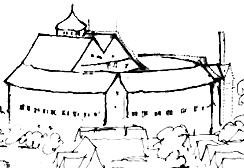
This classical play which was written by William Shakespeare, was one of only a few plays which had more female roles than usual, due to the time it was written which was said to be written in 1599 or the early 1600's, the only people who were allowed to perform on stage were males. So for Shakespeare to write as many female roles as this was quite rare. This was first and traditionally since been performed at the famous 'Globe Theater. The original staging of The Globe Theater is in the name, its circular but more of a thrust staging than theater- in -the -rounds. It was made out of any wood available and had no stairs so people who paid to stand for a price of 1 pence in the late 1500's and early 1600's would have no way of sneaking on sitting down for a seat which had price of 2 pence. However theater to this day is very much different to how the audience would be in 1599. Even though the audience had paid to watch the performance very many of them would not even watch and talk to one another, the actors would actually be the bottom of the pile, the audience would always take the top priority. Acting at the Globe Theater was actually quite a challenge for the actors, as audiences would heckle, throw objects and in general just being rude. But because they paid to watch they had the most power. The actors however would ignore this and carry on as professional as possible, keeping a loud projection so the whole of the theater could hear. Also making sure that their body language was bigger than usual so could be seen from far away of high up in the balconies.Comparing this to today's contemporary, they still perform with the same style of over exaggeration of the body language and loud projection of the voice. However the socially this would be performed to a much respected audience. It would not only be performed in the globe theater as it only would during 1599 but can be a traveling show to local theaters an example of a company who does this is 'The Royal Shakespeare Company'. Relevance such as strength is still relevant to today which is shown from the start of the play with the wrestle between Oliver and Orlando. Showing that there is still competition to show strength and showing the weak. Another relevance is when Rosalind is disguised as a man when Phebe starts to fall in love with her. Even though the character Phebe thought Rosalind was a man, the audience could have a mixed controversial view on this. As to this day we are more open and friendly when it comes to homosexuality, during the late 1500's this could have caused some uproar within the audience. This was because during that period it was very much religious and they were all very passionate about Christianity who was believed that homosexuality was a sin. However to this day its not and in the modern day people decide not to have any religion at all. But Shakespeare must have known this might have caused some controversy when writing this within his script. Another example of this from the play is when Rosalind is disguised as Ganymead, while Silvius starts to fall for her, even though in that time and moment she was dressed as a man.
Culturally the play could be performed different in the ways of basing it in modern times e.g. basing it in a club with party outfits compared with the traditional classical outfits worn in 1599 which were flowing dresses with tight corsets for the females characters (but worn by the males). however most contemporary performances would stick to traditional costumes as shown from below:
Scale model of RSC set of 'As You Like It':
Performance of RSC production of 'As You Like it' with Orlando singing his heart and soul dedicating it to his love and crush Rosalind.

Globe Theatre, 16th century design:

The performance style of the play helped to address this across very well because some scenes jump from being in the forest to indoors, but its very obvious from the start of the scene from where they are for example when the Duke enters he says:
'Now my co-mates and brothers in exile, hath not old custom made this life more sweet than that of a painted pomp? are not these woods more free from peril than the envious court?'
Showing that from the first sentence of the first character to appear within the scene, Shakespeare points that they are no longer inside but in the woods. Other styles of the play is comedy, especially with specific characters such as the fool called Touchstone. Who is always moaning yet is loved by the audience very much and Romance, which is the main focus in many of Shakespeare's plays, this includes characters such as Rosalind and Orlando. Not to mention the surprise four weddings at the end of the play.
This whole speech is a strong example of Shakespeare using antithesis; opposites e.g. on this hand...but then on the other hand. Showing that love is a very confusing feeling to have and think about. Which would defiantly connect to contemporary audiences. Other connections that this play has to a contemporary audience is the humor, the comedy is still very much relevant and still makes audiences laugh to this day. Much of this humor comes from the characters Touchstone and Audrey.

Beth for the most part you have described and discussed the original performance conditions of As You Like It, summarised the themes of the play and provided details of how they might reflect the particular culture and conventions of the time. I think it would be helpful for you to read this back to yourself out loud as some parts seem confused and slightly muddled. When talking about the play try and make more connections between the text, the staging, the characters/themes and how this would have been received by the audience at the time. You could provide more examples to support your thoughts about how the play is received by an audience today, can you find clips of contemporary film or stage interpretations? This could help explain how some of the themes/conventions accepted by an Elizabethan audience have been adapted to become as relevant for us.
ReplyDeleteThis is a Pass as it stands, however with some more detail and clearer analysis is could achieve a higher grade.
Also watch your spelling: Theatre
ReplyDelete